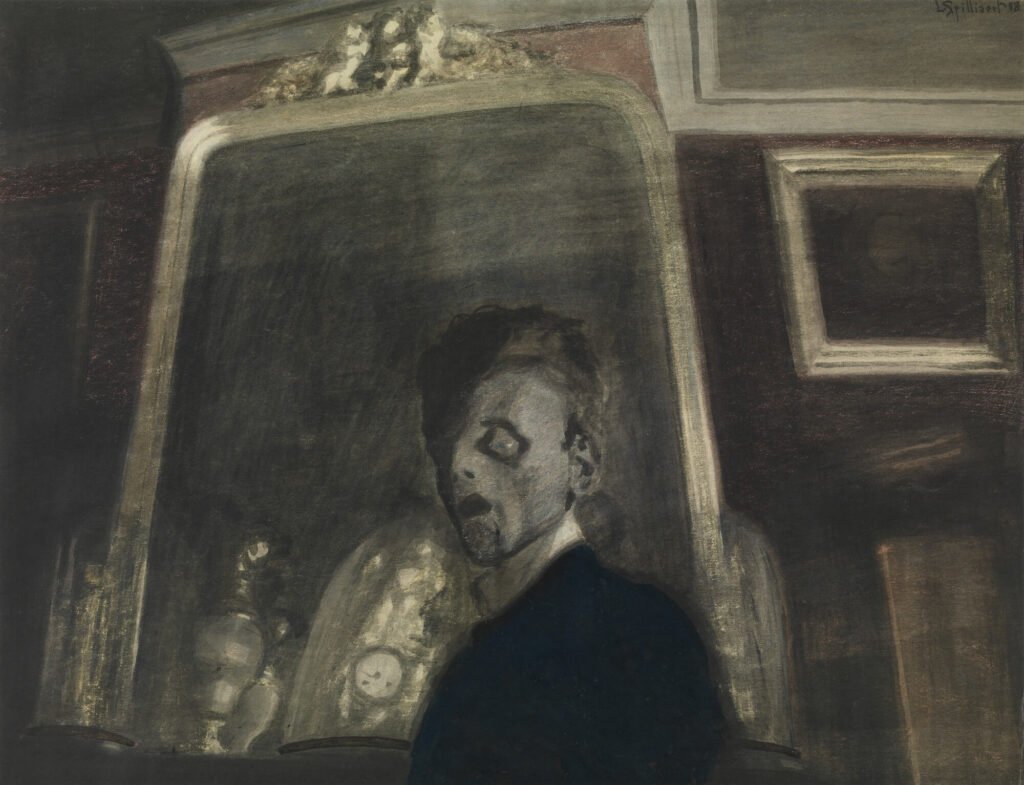
Léon Spilliaert, Self-portrait with Mirror, 1908. Indian ink wash, watercolour and coloured pencil on paper. Mu.ZEE, Collection of the City of Ostend.
Photo: Hugo Maertens
You are upset, and within seconds you are also upset about being upset.
The first feeling concerns something that happened. The second concerns what it means that you are still reacting this way.
You have been meditating.
You understand attachment.
You have read enough about presence to know that you should, presumably, be handling this differently.
Before you have had time to understand your anger, you are assessing the spiritual quality of having it.
This kind of self-surveillance can sound remarkably compassionate.
Are you allowing the feeling?
Are you observing it without identification?
Are you responding from love?
Each question can be useful in a particular situation. Together, repeated without relief, they can turn ordinary experience into a continuous examination. Every feeling arrives with paperwork. Even the wish to stop examining yourself becomes something to examine.
A practice intended to make room for life begins to demand an account of how well you are living it. There is always another correction to make, another reaction to investigate, another indication that you have not quite arrived.
The inner supervisor has learned to speak softly but its expectations remain considerable.
When Attention Becomes Inspection

Odilon Redon, The Eye like a Strange Balloon Mounts toward Infinity, 1882. Lithograph from the album À Edgar Poe. Los Angeles County Museum of Art
Paying attention to ourselves can open possibilities.
We notice an impulse before acting on it. We recognize that a familiar argument has begun again. We discover that the resentment we have been calling generosity is, in fact, resentment.
Such attention can make us more honest. It can also become a form of inspection in which the purpose of noticing is to locate whatever needs correction.
Under this arrangement, awareness is always on duty.
A conversation becomes an opportunity to assess whether we are sufficiently present. Rest requires confirmation that we have released our attachment to productivity. Pleasure raises questions about whether we are becoming dependent on it. A quiet moment is interrupted by the need to establish whether the quiet is authentic.
The standards are often vague enough to be impossible to satisfy.
How present is present enough?
What would sufficient gratitude feel like?
How can we establish that we have surrendered without turning surrender into another achievement?
Because there is no clear answer, the checking continues.
Attention gradually narrows around the spiritual maturity of the person paying attention.
We may hear less of what someone is telling us because we are busy observing our own response. The world becomes material for an assessment whose real subject is always ourselves.
The Emotion and the Verdict
Spiritual language sometimes gives emotions a hierarchy.
Peace, gratitude and love appear to belong to the life we should be cultivating. Anger, envy and fear become signs of a less developed condition.
The distinction can seem reasonable until it begins to determine which experiences we are allowed to acknowledge honestly.
Suppose someone tells you good news and you feel envy. The feeling may reveal a desire you have struggled to admit, a disappointment that remains painful, or a habit of comparing your life with theirs. None of this makes envy an infallible guide. It gives you something to understand and a choice about how to behave.
But if envy is immediately classified as evidence of spiritual failure, understanding becomes more difficult. You have a reputation to protect, even if the only person judging you is yourself. You may rush to perform generosity before admitting what the news has touched.
The same difficulty arises with anger. Being angry does not decide whether we should confront someone, withdraw, apologize, or wait until we can speak more carefully. It also does not, by itself, establish that our perception is wrong. Something objectionable may actually have happened.
An emotion can be acknowledged while the conduct that follows it remains open to scrutiny. We can take responsibility for hurting someone without treating the original feeling as a moral offence.
Self-surveillance tends to collapse these questions. The presence of the feeling becomes the verdict. A difficult afternoon is entered into the record as evidence of an insufficiently transformed person.
John Welwood’s discussion of spiritual bypassing offers a related perspective on how spiritual ideals can be used to avoid difficult emotions.
Acceptance with Conditions
Acceptance can acquire a private deadline.
We agree to allow sadness because we expect allowing it to make it disappear. We observe anxiety in the hope that observation will quickly produce calm. We stop resisting a feeling, then check whether this improved approach has persuaded the feeling to leave.
The feeling was welcome on the understanding that it would be brief.
When it persists, disappointment returns.
Perhaps we have not accepted it properly.
Perhaps our acceptance was secretly resistance.
Perhaps we need to examine the part of ourselves that wants an outcome.
There may be something useful to discover in these questions. There is also a point at which they become another way of refusing the experience we are having.
Sadness must now survive a second demand: it should be accompanied by the correct degree of openness, patience and composure.
We begin to require a spiritually acceptable manner of suffering.
Someone grieving may be restless, repetitive, resentful or unable to find meaning in what happened.
A practice that permits grief only when it looks spacious and wise offers fairly limited hospitality. It allows the feeling after its inconvenient qualities have been removed.
Even self-compassion can become caught in this arrangement. We notice that we are judging ourselves and immediately judge ourselves for failing to be compassionate. The instruction to be gentle arrives in the familiar voice of disapproval.
There is no obvious end to this sequence. Any attempt to escape it can be reviewed for correctness.
Acceptance becomes another task at which we are capable of failing.
The Promise of Perfect Alignment
Alignment can be a useful word when it describes the relationship between what we value and how we act. We may recognize that our work contradicts our commitments, or that we keep agreeing to things we do not want to do.
The word becomes more troubling when it promises an inner condition through which life will finally proceed without friction.
Within that promise, disappointment suggests a hidden blockage. Conflict indicates that we have departed from love. Exhaustion invites an investigation into our resistance. If events are unpleasant, there must be some part of our inner life that has failed to cooperate.
This gives us an almost unlimited responsibility while making the circumstances around us strangely difficult to discuss.
An exhausting arrangement can remain intact while the person exhausted by it works on their attitude. Someone else’s disregard becomes an occasion to investigate why we are still reactive.
We might spend hours asking whether our anger has lowered our vibration and never ask whether a boundary has been repeatedly ignored.
The appeal of perfect alignment is understandable. It offers the possibility that sufficient inner work will protect us from the uncertainty of depending on other people and living within conditions we cannot control.
But other people continue to make their own decisions. Work can demand more than we can give. Loss can interrupt a meaningful life. No degree of gratitude establishes immunity from disappointment.
A practice that cannot acknowledge these limits leaves us responsible for explaining every difficulty through a defect in ourselves.
How the Inner Critic Learns Spiritual Language
For someone accustomed to making themselves acceptable, spiritual ideals can provide a new vocabulary for an old task.
Perhaps anger has always felt dangerous because it risks disapproval. Perhaps being easy to be around has been treated as the price of belonging. In that context, the instruction to remain peaceful can sound reassuringly familiar.
It supplies a more elevated reason to continue concealing whatever might inconvenience someone else.
The person may sincerely believe they are becoming less attached to approval while still organizing their inner life around acceptability.
This is one reason the tone of a practice deserves attention. A compassionate vocabulary does not guarantee a compassionate relationship with ourselves. We can use words such as healing, openness and surrender while subjecting ourselves to relentless correction.
The content of the ideal changes. The requirement to earn permission to be as we are survives.
Something similar can happen when spirituality adopts the logic of productivity.
Meditation becomes a measure of discipline. Journaling must produce insight. Rest should restore our capacity to improve. Every experience is expected to contribute to growth, and a day without a recognizable lesson seems to have been poorly used.
Even surrender must demonstrate results.
Under these conditions, spiritual practice offers very little relief from the demand to work on ourselves. It expands that work into places that previously seemed exempt. There is now a correct way to breathe, to rest, to receive kindness, and to be disappointed.
The self is never entirely off duty.
What the Practice Makes Possible
The response to this problem can easily become another assignment. We begin checking whether we are checking too much. We try to cultivate a more relaxed relationship with ourselves and then assess the quality of our relaxation.
The examination continues under a revised set of rules.
Perhaps a more useful question concerns what a practice makes possible beyond the practice itself.
Does it help us listen to another person?
Can we admit that we have hurt someone without spending the entire conversation defending our spiritual identity?
Can we recognize an unwanted arrangement and do something about it?
These questions bring attention back to particular situations. They give us something more concrete to consider than whether our inner state has reached the appropriate standard.
After an argument, we may need to apologize for what we said.
We do not need to become a person incapable of irritation before the apology can be sincere. Gratitude for someone’s care can coexist with disappointment in something they have done. A boundary can remain necessary while we are uncertain, guilty or afraid.
Action becomes possible within an imperfect inner life.
There should also be room to put a practice down.
A journal can close without a revelation. Meditation can end without a satisfying account of what it achieved. We can return to cooking, conversation or an unfinished task without continuing to inspect the person doing them.
The ability to leave the exercise may be part of what gives it value. It has served its purpose if it helps us return to a world that does not exist merely to assess our progress.
When the Examination Ends
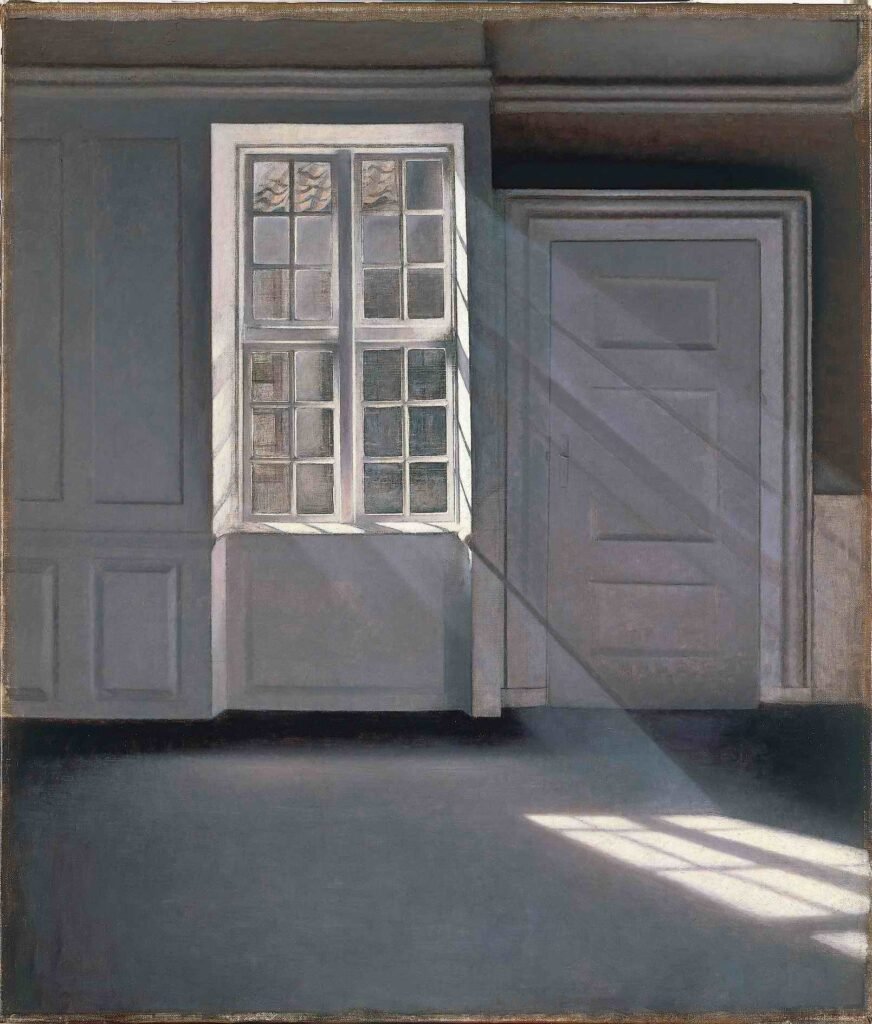
Vilhelm Hammershøi, Dust Motes Dancing in the Sunbeams, 1900. Oil on canvas. Ordrupgaard, Denmark
Spiritual practice can ask something of us.
Honesty may require acknowledging motives we would prefer to conceal. Responsibility may involve changing habits, tolerating discomfort, or giving up an account of ourselves that has become convenient.
These demands have consequences in a life shared with others. They concern what we do with what we discover.
The demand to maintain a consistently admirable inner atmosphere is harder to justify.
It can make us preoccupied with our own development while leaving little room for the ordinary ambiguity of experience. We become skilled at discussing our reactions and less able to say plainly that we are tired, hurt, or in need of help.
A practice worth returning to should allow such admissions. It should make room for a disappointment that has not become wisdom and a grief that has no useful conclusion. Some experiences will remain unresolved long after we have learned to describe them carefully.
We can continue living while they remain unresolved.
There are people to listen to and decisions that cannot wait for complete inner agreement. The food can be eaten while it is still warm. An afternoon can pass without producing evidence of transformation.
For a while, there may be something more interesting to attend to than whether we are attending to it correctly.