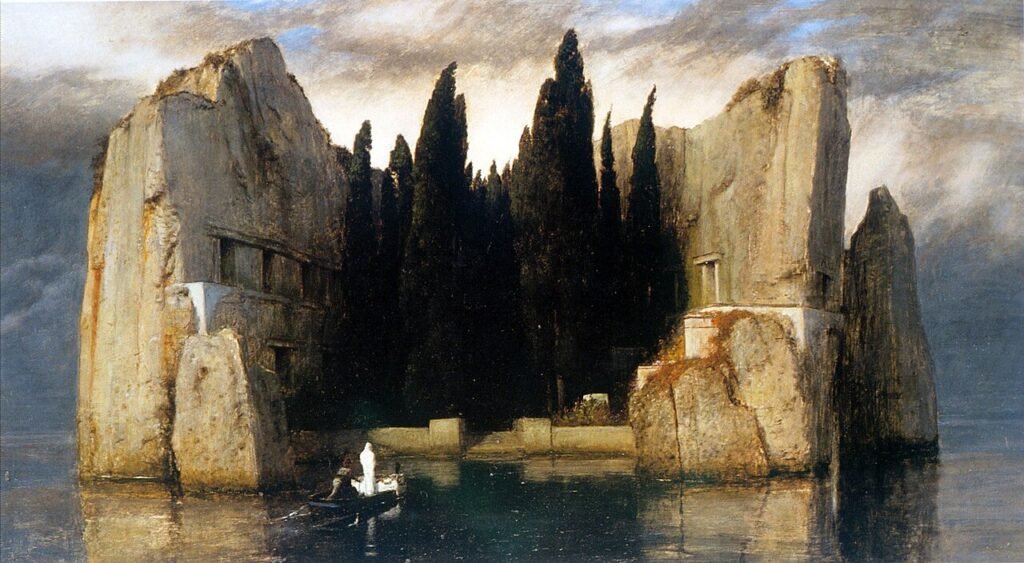
Arnold Böcklin, Isle of the Dead, 1883. Alte Nationalgalerie, Berlin
The dead continue to make demands.
Not literally, perhaps. They do not object, withdraw affection or correct our version of events.
But their preferences survive them with remarkable efficiency.
We remember what they would have approved of, what would have disappointed them, which choices they considered respectable, which beliefs they treated as non-negotiable.
Long after a person loses the ability to ask anything of us, we may continue answering to them.
Sometimes this feels like love.
Sometimes it feels like guilt.
What do we owe the dead when those two become difficult to separate?
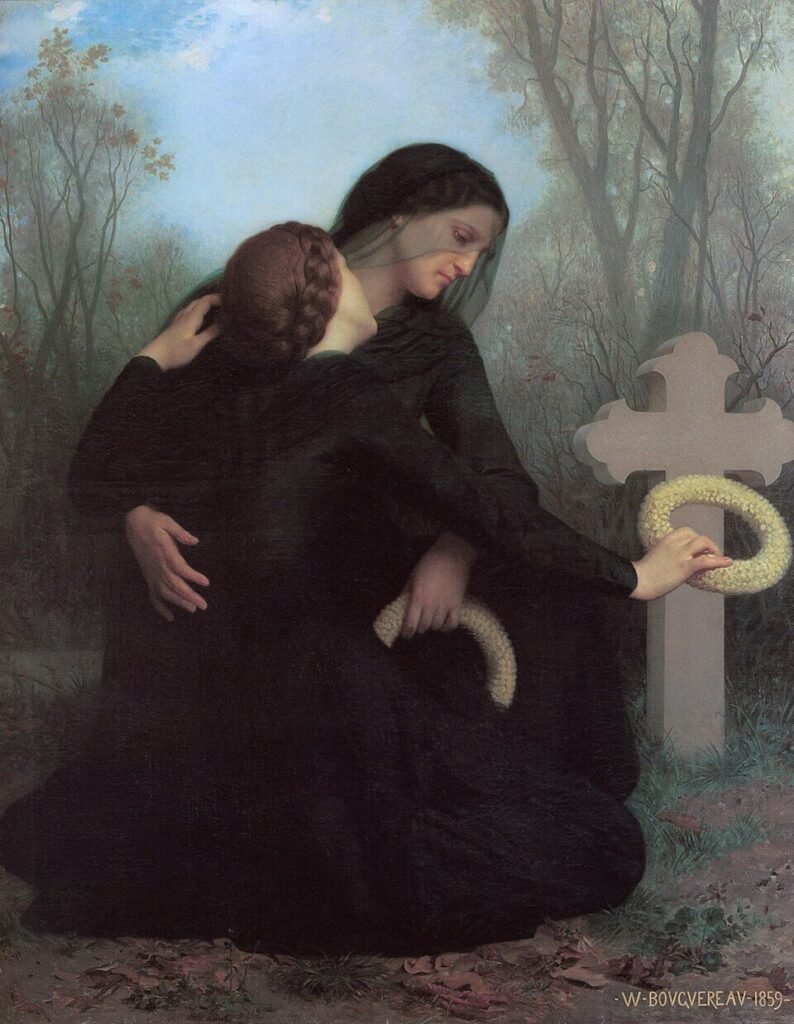
William-Adolphe Bouguereau, Le jour des morts, 1859. Musée des Beaux-Arts de Bordeaux
Often it is difficult to tell the difference.
There are ordinary ways of remaining faithful to the dead: keeping photographs, visiting graves, cooking a particular meal, preserving a piece of furniture nobody actually likes enough to use.
There are names we repeat, anniversaries we observe, stories that become more polished with every telling. These practices allow the dead to remain part of a world from which they are physically absent.
But what survives a person is rarely limited to objects and memories. What reaches us also includes expectations, religious commitments, political convictions, and ideas about work, marriage, gender, money, respectability, duty and what constitutes a life worth living.
Sometimes these values become so entangled with the person who gave them to us that questioning one begins to feel like betraying the other.
And so a more difficult question appears.
Are inherited beliefs still ours if we keep them only out of loyalty?
The Authority of an Absence
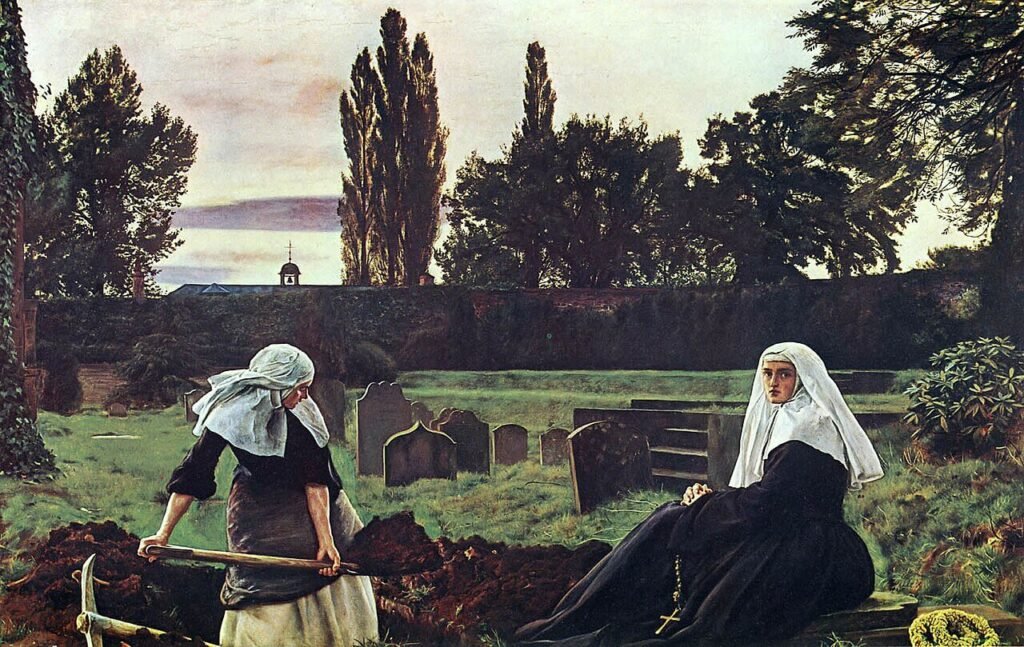
John Everett Millais, The Vale of Rest, 1858. Tate Britain, London
Death does something strange to disagreement.
Arguments that were possible while someone was alive can become morally uncomfortable once they are gone. The living person could defend themselves, reconsider, become angry, surprise us or change their mind.
The dead cannot.
Their opinions become strangely fixed.
We say:
He would have hated this.
She would never have accepted that.
Such statements may be completely accurate. But they also grant the dead a peculiar authority: the authority of never having to encounter what happened next.
Death interrupts the possibility of revision. Yet the living sometimes treat the final known version of a person as permanent law.
There is something understandable about this.
Living on after someone’s death can feel like moving beyond the person they once knew and it’s easy to experience it as abandonment.
We are still here.
They are not.
Survival itself can make freedom feel indecent.
The Guilt of Becoming Someone They Never Knew
There is a form of grief that receives less attention than missing the dead: the grief of becoming someone they never had the chance to know.
Years accumulate after a death.
New friendships appear.
Beliefs collapse.
Relationships begin and end.
Languages, cities, careers and habits enter a life that the dead never witnessed.
Eventually, enough of us may belong to a time they never shared.
This can produce an unexpected guilt.
There is something unsettling about realizing that someone central to your life would now require an explanation of who you are. Stranger still is the possibility that they might not approve.
Would they understand the person I love?
Would they understand why I left?
Would they understand why I no longer believe?
These questions are impossible to answer precisely because death freezes one participant in the relationship while the other continues moving.
The temptation is therefore to remain legible to the dead.
But a life spent remaining understandable to people who knew us years or decades ago would require something close to self-arrest.
The Beliefs We Do Not Have to Keep
Perhaps one of the strangest assumptions surrounding inheritance is that love requires ideological continuity. We rarely apply this rule consistently to the living.
We can love a parent and disagree with their politics.
Love a friend while rejecting their theology.
Love someone whose understanding of marriage, work, morality or family differs profoundly from ours.
Love does not normally require intellectual duplication. Death should not suddenly make duplication necessary. To love someone is not to become the preservation mechanism for their worldview.
This becomes especially important when inherited values caused harm.
Cultures can transmit prejudice as easily as affection and silence as easily as wisdom.
Religious traditions can hand down beauty and terror in the same gesture. Inherited faith can become especially difficult to question when doubt feels like disloyalty rather than inquiry.
A beloved person can have been generous in one part of life and deeply mistaken in another.
The difficulty is that rejecting what harmed us may feel like rejecting the person who carried it. But people are not identical to their beliefs.
We can be grateful for what someone gave us without declaring everything they gave us good.
We can understand why they believed something without continuing to believe it.
We can even recognize that certain values made sense within the conditions of their life while refusing to reproduce them within ours.
Sometimes the most mature form of inheritance is not continuation but discrimination: deciding what deserves to survive.
We Inherit More Than We Are Required to Keep
Inheritance has an oddly passive grammar.
Something is handed down. Something is received. But receiving is not the same as consenting. No one chooses the moral world into which they are born.
Before we are capable of evaluating anything, we inherit stories about who we are supposed to be, what respectable people do, what God requires, what kind of suffering should be endured quietly, whom we owe loyalty to and which subjects should never be discussed.
Some of these inheritances become foundations. Others become burdens. Most are mixtures of both.
Perhaps adulthood consists partly in turning inheritance into a conscious relationship.
Not asking only:
What was I given?
but also:
What am I willing to carry forward?
This does not require contempt for the past. Quite the opposite. Taking inheritance seriously means refusing to treat it as automatic.
A tradition that cannot survive examination is being preserved through obedience rather than conviction. A value maintained solely because questioning it produces guilt is no longer simply a value; it has become a debt.
And debts to the dead are particularly difficult to repay because there is no moment at which the creditor can declare the account settled.
The Dead We Construct
There is another complication.
The dead whose judgment we fear are partly our creation.
Memory is selective even when it is sincere. Over time, a person can become condensed into a handful of gestures, sentences and convictions. Their contradictions fade. Their unfinished thoughts disappear. What remains is often a more coherent character than the living person ever managed to be.
Families are particularly good at producing these posthumous figures.
Your mother believed…
Your grandfather would have wanted…
The dead become rhetorical authorities.
Sometimes they are invoked to settle arguments they never participated in. Their imagined preferences are used to discipline the living precisely because they cannot object to being recruited.
But even our private versions of the dead are constructions. When we ask what someone would think of our life now, we are conducting both sides of the conversation.
We supply the objection.
We imagine the disappointment.
We pronounce the verdict.
This does not make the relationship unreal. It simply means that at some point we must distinguish the person we lost from the internal authority we have built in their image.
The second can continue governing us long after the first is gone.
What Fidelity Might Actually Mean
If fidelity does not require obedience, what remains?
Perhaps more than we think.
We can remember accurately rather than reverently.
We can refuse the temptation to turn the dead into saints simply because they can no longer defend their complexity.
We can tell their stories.
We can preserve what was generous in them.
We can acknowledge what was difficult.
We can recognize what they gave us and what they failed to give.
We can repair harms they could not repair themselves.
We can interrupt patterns they handed down without knowing how to stop them.
And sometimes we can carry a value forward precisely by changing its form.
An insistence on endurance might eventually become the decision that we should not have to endure the same things.
Continuity does not always look like repetition.
Sometimes honoring what people struggled for means allowing us to struggle less.
Sometimes loving where we came from means refusing to recreate it.
An Obligation to the Living
There is a danger in giving the dead unlimited moral authority.
They cannot bear the consequences of our obedience.
We can.
The dead do not have to remain in the marriage, inhabit the profession, conceal the relationship, maintain the house, attend the church, reproduce the silence or live inside the identity preserved on their behalf.
The living do.
This does not mean that only present desire matters. We owe something to history. We owe something to memory. Human beings become intelligible partly through continuity with those who came before them.
But obligations compete.
Whatever we owe the dead exists alongside what we owe the living: our partners, children, friends, communities and ourselves. There may even be obligations to people who do not yet exist, who will inherit whatever we choose to preserve.
An inherited rule may therefore deserve a question that is rarely asked:
If I continue this out of loyalty, who will have to live with it?
The answer may matter more than whether an ancestor would approve.
Letting the Dead Be Dead
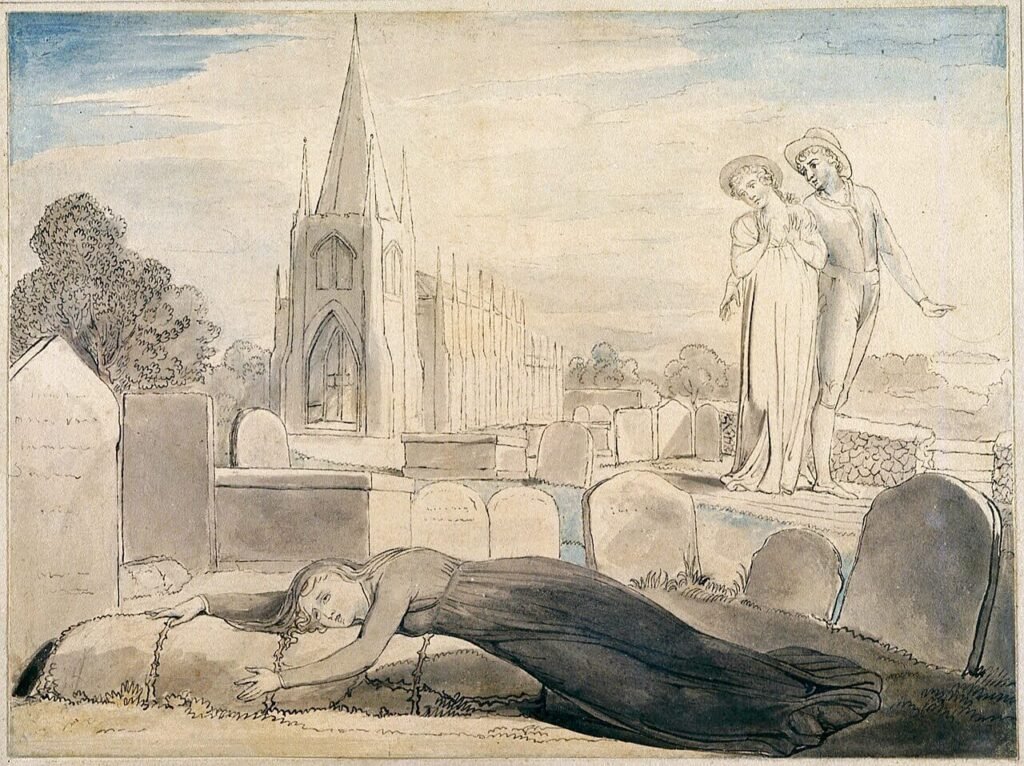
William Blake, The Widow Embracing Her Husband’s Grave, 1805–1808. Yale Center for British Art, Paul Mellon Collection
Perhaps part of mourning is eventually accepting something more difficult than absence.
The dead no longer get to decide.
This can sound cruel because we associate love with continued presence. But grief does not necessarily require severing the bond with the dead; it can also mean allowing that bond to change. There may be tenderness in allowing a life to be complete rather than endlessly extending its authority into another person’s future.
Someone can matter enormously without being granted permanent jurisdiction.
Their life was theirs.
Ours is ours.
The boundary does not diminish love. It may be what allows love to survive without becoming obedience.
We can carry photographs and stories. We can repeat their jokes. We can cook their food badly. We can miss them decades later. We can recognize their gestures unexpectedly appearing in our own hands. We can preserve what deserves preservation and grieve what cannot continue.
And we can disappoint them.
Or rather, we can accept the possibility that we might have.
There is no final tribunal in which every decision must be defended before an assembly of our ancestors. There is only the difficult work of deciding which parts of the past deserve a future.
Perhaps this is what we owe the dead: not obedience, and certainly not the sacrifice of every life they would have struggled to understand.
We owe them the dignity of remembering that they were complicated people rather than commandments.
We owe them gratitude where gratitude is due, truth where truth is due, and grief without the promise of obedience.
And perhaps we owe them something else as well:
the willingness to let their lives be finished,
so that ours do not have to be.