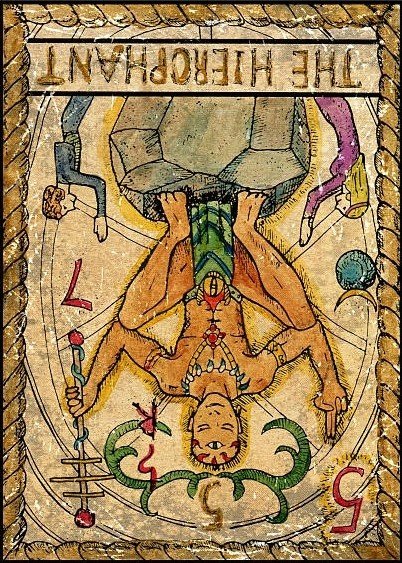
The Hierophant Reversed Meaning is closely connected with questioning tradition, challenging inherited beliefs, and discovering personal truth through lived experience. While the upright Hierophant represents institutions, teachers, and established systems of wisdom, the reversed Hierophant invites us to ask whether those structures still serve our growth—or whether they have become limitations disguised as certainty.
Rather than rejecting tradition for its own sake, the Hierophant reversed asks a deeper question: Which beliefs are truly mine, and which have I inherited without reflection?
What Is the Hierophant Reversed Meaning?
The Hierophant Reversed Meaning goes beyond simple rebellion. It represents the movement away from borrowed truths toward personal understanding. Rather than rejecting every tradition, this card encourages discernment—choosing beliefs consciously instead of accepting them automatically.
The Hierophant is the archetype of tradition, collective wisdom, and spiritual authority. He represents the priest, teacher, mentor, or institution responsible for preserving and transmitting knowledge across generations. His role is to provide structure, continuity, and a shared language through which communities understand the sacred.
When the card appears reversed, this orderly structure begins to loosen. External authority loses its unquestioned status, making room for personal discernment and direct experience. The Hierophant reversed encourages independent thinking, spiritual maturity, and the courage to question established narratives.
Its central lesson is simple but profound:
Are you living according to borrowed truths, or by wisdom you have discovered for yourself?
The Teacher Turned Upside Down
The Hierophant, sometimes known as The Pope in older decks, is seated on a throne, blessing two abject acolytes. He represents the passage of divine wisdom through a social structure: church, school, family, government… Upright, the card insists on the absolute necessity of common frames of reference, shared traditions, and teachers who transmit knowledge.
The reversal dismantles this whole scheme. The “sacred structure” is no longer fixed and knowledge no longer descends from above, but rather is apprehended from within. The priest becomes the heretic, the teacher becomes the trickster, and the institution loses its exclusive claim to truth.
This archetype appears throughout cultures: the Gnostic who defies the church in order to find direct access to knowledge (gnosis), the Protestant reformer who rejects the universal authority claimed by Rome, and the mystic who leaves the monastery to confront God alone. Each one has rejected the collective in order to recover the living essence.
The Hierophant Reversed Meaning in Psychology
Psychologically, the Hierophant reversed reflects the process Carl Gustav Jung described as individuation—the lifelong movement away from unconscious conformity toward an authentic self.
Throughout childhood, we naturally absorb the values of our family, culture, religion, and society. This process is necessary. Yet genuine maturity eventually requires examining these inherited beliefs and asking whether they truly belong to us.
The Hierophant reversed symbolizes this critical stage of development.
Erich Fromm explored a similar tension in Escape from Freedom, arguing that liberation from external authority often creates anxiety. Faced with uncertainty, many people seek new authorities to follow rather than cultivating an inner foundation.
For this reason, the Hierophant reversed carries an important warning: rejecting one system without developing inner discernment often leads only to replacing one form of dependence with another.
The Hierophant Reversed Meaning in Spirituality
Spiritually, the Hierophant reversed often appears during periods of deconstruction.
Religious doctrines, spiritual communities, or long-held beliefs may begin to feel restrictive. What once offered certainty may now feel disconnected from lived experience.
This does not necessarily signal the loss of faith. More often, it represents a movement toward a more direct relationship with the sacred.
Throughout history, many mystical traditions emerged precisely because individuals sought personal encounters with the divine beyond institutional authority. The Hierophant reversed reflects this timeless movement from inherited belief toward living experience.
The Hierophant Reversed Meaning in Love
In love readings, the Hierophant reversed often points toward relationships that challenge convention.
Partners may reject traditional expectations surrounding commitment, marriage, gender roles, or family structures. Rather than following established models, the relationship develops according to values consciously chosen by both individuals.
At a deeper level, the card asks whether commitment arises from genuine freedom or from social obligation.
Authentic love cannot simply be inherited—it must be chosen.
The Hierophant Reversed Meaning in Career
Within career readings, the Hierophant reversed frequently reflects dissatisfaction with rigid institutions, excessive bureaucracy, or restrictive workplace hierarchies.
Many people encounter this card while questioning conventional career paths or considering freelancing, entrepreneurship, creative work, or independent research.
Its appearance encourages innovation while reminding us that independence requires responsibility as much as freedom.
The Shadow of Rebellion
The Hierophant reversed does not always represent liberation. It can simply represent rebellion for rebellion’s sake, cynicism without creativity, opposition without a vision.
Additionally, there remains a risk of being trapped by false teachers, or cult leaders, or ideologies pretending to be alternatives to orthodoxies.
If tradition, both present and historical, is ruptured, there has always been the potential for harm. F
or example, while the Protestant Reformation did liberate believers from Rome, it also opened the door to forms of fanaticism. Yes, Gnostic sects were liberatory, but with dangers of elitism, if not secrecy.
More modern examples still include jettisoning religious authority and attacking faith-based organized religions, that may involve pursuing some form of liberation and enlightenment as a result of following a guru, or worse yet, a crooked conperson selling “freedom” as a control trap.
How to Work with the Hierophant Reversed
Instead of asking whether tradition is good or bad, this archetype encourages a more nuanced approach.
Practice observing inherited beliefs with curiosity rather than immediate rejection.
Helpful practices include:
- Journaling about beliefs you inherited from family, religion, or culture.
- Identifying traditions that genuinely enrich your life.
- Releasing habits maintained only through obligation.
- Studying teachers who encourage independent thinking rather than unquestioning obedience.
- Developing practices that strengthen your own inner authority.
Growth begins not by rejecting every tradition, but by consciously choosing which ones deserve to accompany you.
Frequently Asked Questions
What is the Hierophant Reversed Meaning?
The Hierophant reversed represents questioning authority, challenging inherited beliefs, and discovering personal truth through direct experience rather than unquestioned tradition.
Is the Hierophant reversed a bad card?
No. Although it can signal periods of uncertainty or conflict with established systems, it ultimately encourages authenticity, critical thinking, and spiritual maturity.
What does the Hierophant reversed mean in love?
In love readings, the Hierophant reversed often symbolizes unconventional relationships, freedom from social expectations, and commitment based on conscious choice rather than obligation.
What does the Hierophant reversed mean spiritually?
Spiritually, the card often marks a period of deconstructing inherited beliefs and developing a more personal relationship with faith, meaning, or the sacred.
Final Thoughts
The Hierophant Reversed Meaning ultimately reminds us that authentic wisdom cannot simply be inherited. Traditions, institutions, and teachers all have value, but they become meaningful only when tested through personal experience. Rather than encouraging rebellion for its own sake, this archetype invites us to develop an inner authority capable of discerning truth from habit.
The Hierophant reversed is ultimately about reclaiming personal authority.
It invites us to move beyond unquestioned obedience without falling into empty rebellion. True wisdom is neither blind conformity nor perpetual resistance. It emerges through lived experience, honest reflection, and the courage to test inherited beliefs against reality.
When this card appears, it asks us to examine the stories we have accepted without question and to discover whether they still support the people we are becoming.
Its question remains beautifully simple:
Am I living according to borrowed truths—or according to wisdom I have forged through my own experience?
Continue exploring the Arcana series: Discover more tarot archetypes and symbolic interpretations in the Arcana collection.