Frederic Leighton, Orpheus and Eurydice, 1864. Oil on canvas. Leighton House, London
We may want someone close and feel more at ease in their absence.
We may long for home while remembering exactly why we needed to get away.
We may want a particular future and recoil from the daily life required to sustain it.
These feelings can coexist with considerable force. Each has its own reasons, its own history, and something it is reluctant to lose.
The astrology of ambivalence offers an appealing language for these competing desires. Different planets can represent different concerns; aspects can give a recognisable form to tension.
A chart allows us to speak about several desires without immediately reducing them to inconsistency. Yet a reading can move quickly from describing this plurality to trying to resolve it.
One desire becomes authentic, another defensive. One belongs to our potential, another to a pattern we must outgrow.
The contradiction acquires a developmental assignment.
We arrive wanting to understand why we feel divided. We leave believing that, with enough work, we should eventually stop.
Which Desire Gets to Be Real?
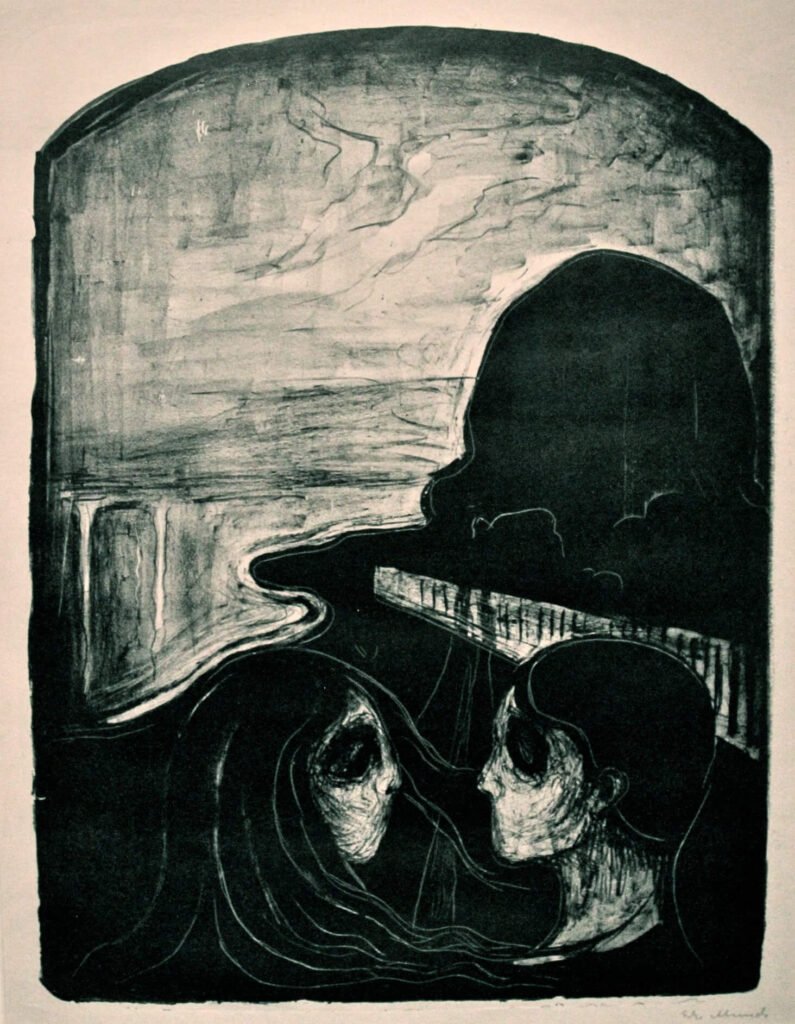
Edvard Munch, Attraction I, 1896. Lithograph
Ambivalence can be mistaken for weak feeling: we supposedly do not want something enough to know what to do.
Psychological accounts of attitudinal ambivalence make a useful distinction here.
Positive and negative evaluations can coexist, each strongly held. Feeling drawn to something and repelled by it can involve considerable conviction in both directions.
The difficulty may be that we know quite well what attracts us and what we resist.
In modern astrological writing, Venus–Uranus contacts are often associated with tensions between attachment and independence. Within that symbolic vocabulary, we might recognise the pleasure of connection alongside a wish to preserve freedom.
The description becomes more restrictive when one concern is automatically treated as the truth and the other as interference.
If the reading begins with the assumption that we really want intimacy, our wish for distance can become a fear to overcome. If it begins with the assumption that we really need freedom, attachment can become evidence that we are compromising ourselves.
The same conflict receives opposite verdicts, depending on which desire the interpretation grants authority.
Fear may be involved. So may affection, exhaustion, curiosity, loyalty, pleasure, or a preference for forms of relationship that leave substantial room for solitude.
The chart alone cannot establish which explanation applies.
A wish for distance deserves inquiry before it is assigned a pathology. A wish for closeness deserves the same care before it is dismissed as dependency. Both may tell us something we need to hear.
The Promise of Integration
Integration is an attractive word. It suggests that the parts of a person can become more intelligible to one another, that we can recognise what we have disowned and respond with greater choice.
There is value in that possibility.
Someone may discover that closeness becomes easier when they can ask for time alone. Another may find that independence feels less urgent when affection no longer arrives with an expectation of constant availability.
But integration can also carry an expectation of eventual harmony.
Every difficult aspect becomes a lesson whose successful completion should produce a coherent person. Whatever remains troublesome is taken as evidence that the work is unfinished.
Some values continue to compete even after we understand them.
A life spent near our family may offer a kind of belonging that life elsewhere cannot reproduce. Living elsewhere may allow possibilities that staying would close.
We can understand both desires, accept their histories, and still find that no arrangement fully honours them.
A reading that promises reconciliation may make this ordinary cost feel like a personal failure.
We begin searching for the attitude, practice, or level of awareness that would allow us to choose without giving anything up.
Astrological symbolism can accommodate a more modest idea of integration: becoming able to acknowledge competing desires, recognise their effects, and negotiate what we can.
The tension may continue. Our way of living with it can change.
What Are We Actually Resisting?
Some apparent contradictions become clearer when we pay attention to the conditions attached to a desire.
A person may want a relationship while resisting the particular role they are expected to occupy within it.
They may want recognition while recoiling from a workplace that treats every achievement as permission to demand more.
They may want to belong to a community while being unwilling to conceal parts of themselves to remain welcome.
A Venus–Saturn reading might frame hesitation as difficulty receiving love, when the person is responding to affection that comes with costly obligations.
A tension between public and private life might be described as an inability to reconcile ambition with emotional needs, while the available working conditions leave little room for either.
These are possible readings, and their usefulness depends on what the person actually lives.
Before asking how someone can become more comfortable with commitment, we might ask what commitment requires of them.
Before treating withdrawal as resistance to growth, we might ask what becomes possible when they withdraw.
This inquiry will sometimes reveal arrangements that can be changed. It will sometimes reveal competing wishes that remain difficult under better conditions.
Either way, the experience deserves more attention than a familiar explanation can provide.
Ambivalence may contain information about a situation as well as information about the person experiencing it.
Choosing Without Inner Unanimity

Félix Vallotton, Interior with Woman in Red, 1903. Oil on canvas. Kunsthaus Zürich
A decision can settle what we will do while leaving much of what we feel unsettled.
We can accept a job and continue to want the time it will consume.
We can leave a relationship and miss the person.
We can stay somewhere by choice and still imagine the life we might have lived elsewhere.
The unchosen possibility may retain its appeal. Its persistence alone cannot tell us whether we chose badly.
Astrology can make this difficult when it encourages us to locate a single direction that expresses the whole chart. We may begin to expect the right choice to feel recognisable across every part of ourselves, as though a valid decision should produce internal agreement.
Few consequential choices offer that assurance.
Sometimes we act because one concern matters more under the circumstances.
Sometimes we accept a cost because we can live with it.
Sometimes we have to decide with incomplete knowledge and feelings that remain divided.
There may be grief in a considered choice. The wish we could not accommodate may return on an ordinary afternoon, without making the life we chose false.
A useful reading can help us describe what each possibility offers and demands.
It can also leave room for a decision whose value depends on how we live it, rather than on our ability to feel entirely certain beforehand.
The Other Person in the Interpretation
Ambivalence becomes especially consequential when another person has to live with its expression.
Someone may care deeply and withdraw repeatedly.
They may want a relationship while remaining unwilling to make the commitments it requires.
Their feelings may be sincere, and their behaviour may still make a shared life difficult.
Astrological interpretation can explain that difficulty as a sign of love the person cannot express.
Distance is explained as fear, inconsistency as intensity, and silence as evidence of a conflict too profound to communicate.
These interpretations can be comforting. They can also encourage us to give greater authority to a chart than to what someone says and does.
A chart cannot verify another person’s private feelings. An interpretation of their conflict remains an interpretation, with consequences for the person who relies on it.
The person who feels divided also has responsibilities. They can be honest about what they can offer, avoid promises they cannot sustain, and recognise the effect of repeated withdrawal.
Making room for contradictory feelings requires attention to everyone involved. Otherwise, one person’s unresolved conflict becomes the arrangement everyone else must live inside.
An Astrology of Ambivalence
An astrological reading does not need to identify a victorious desire.
It can help us ask more precisely what we want, what we resist, and what each concern would require in practice.
It can explore whether a hesitation changes across relationships and circumstances, whether a wish belongs to the life available to us or to an imagined version of it, and which costs we are willing to accept.
Within such a reading, an opposition can remain a way of describing competing concerns. A square can suggest friction worth examining.
Neither needs to become a promise that sufficient maturity will make every part of life fit. There will be contradictions we can soften, arrangements we can revise, and feelings that alter with experience. There may also be desires that remain incompatible in ways we cannot finally solve.
Knowing ourselves can include recognising those limits. We can become more careful with our commitments and more honest about the wishes they leave unanswered.
Astrology has room to name all of this.
A reading can end with a fuller account of the conflict, even when the person leaves still feeling it.