The Tower tarot card is frighteningly easy to fear and, at the same time, just as easy to romanticize.
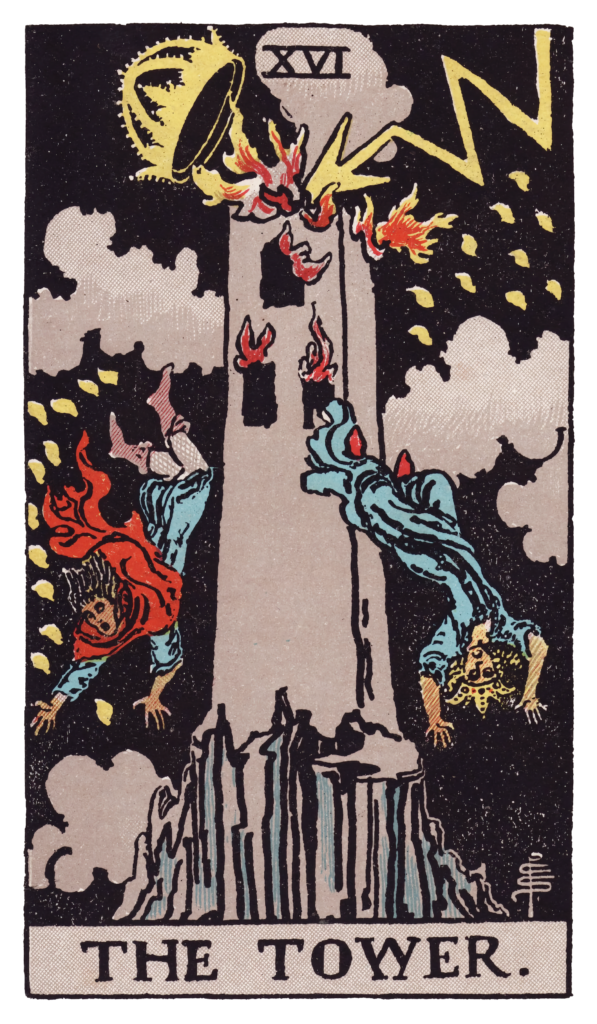
It is an image of a lightning bolt coming out of the dark, a crown being ripped from a burning tower, and two people falling through the air.
Whatever this card represents, it refuses to tell us that things can go back to the way they were.
When The Tower shows up in a reading, reassurance often follows quickly.
The tower was going down anyway. The foundation was rotten. It had to come crashing down. Now something much better can be built.
All of those statements could ultimately turn out to be true. Or they could be lies told while the house is still burning.
We are drawn to The Tower because it shows the loss of control. And yet we are frightened by it for exactly the same reason.
Destruction offers something that gradual change very rarely does: a dramatic moment.
This image tells us that uncertainty will come to an end – whether through violence or otherwise.
And that is where the charm of destruction begins.
We do not always want suffering or turmoil. What we often want is something that can make our decisions for us.
We wait until the relationship becomes unbearable; until the organization exposes its worst self; until a person breaks beyond their limits. Then we can say that there was no alternative.
But The Tower reveals what we chose to overlook while protected by stability. Revelation, destruction, and transformation are three very different actions.
A building can fall and never set anyone free. A disaster can lay bare the truth but never teach someone how to live by it. Ruins can become foundations, but ruins do not become foundations on their own.
The Fantasy of the Clean Break
How much we desire to see change as breakage is revealed by the way we speak about it.
We “burn bridges”, tear everything down, and begin anew; we become new people. These ways of expressing transformation make it a spectacle. They provide a visual separation between the person who entered the fire and the person who emerged from it.
But ordinary change provides little or no visual distinction.
In most cases, we come to know a truth long before we act on it. We leave slowly; we return to things we were trying to leave behind; we carry old behaviours into unfamiliar rooms. A person’s life changes through small actions whose greater implications become clear only later.
That kind of transformation is very difficult to narrate. It does not occur with a lightning bolt.
Collapse gives a story shape. Even suffering is easier to put into order when placed against the backdrop of a catastrophic event.
Before this happened, I was someone; after it, I became someone else. The disaster explains the person who survived it.
A similar pattern exists in many spiritual and political fantasies of the “reset”. The “false self” must die. The “corrupt institution” must be destroyed. The disaster will awaken us. The world must end before the world can begin again.
Some systems are harmful precisely because they continue to stand, and repair can become an excuse for allowing them to continue.
But the idea of complete destruction can also serve as an escape. It allows us to imagine that change cannot happen until everything that existed before has disappeared.
We look for absolute certainty in the form of catastrophe. If everything has burned, we no longer need to determine which parts should be preserved, repaired, or left behind. Catastrophe appears to remove the need for making these distinctions.
But nothing begins from nothing. Even if the external structure disappears, we still carry its architecture within us: its patterns of power, attachment, and avoidance.
We point to the new location as proof that we have changed while reproducing the same patterns inside it. A person can leave one building and begin constructing another out of the same fears.
This may explain why the desire for rupture can become so intense. Each collapse seems to promise the transformation that the previous collapse failed to produce: another relationship, another identity, another departure.
Intensity becomes confused with depth.
Something dramatic happened; therefore, something deep and profound must also have happened.
The Tower tarot card ends a structure. Our love affair with it begins when we confuse the ending of that structure with the emergence of a new self.
A Tower That Deserved to Fall
The Tower is frequently associated with the biblical Tower of Babel, although there is no clear historical evidence that the tarot image directly originated from that story.
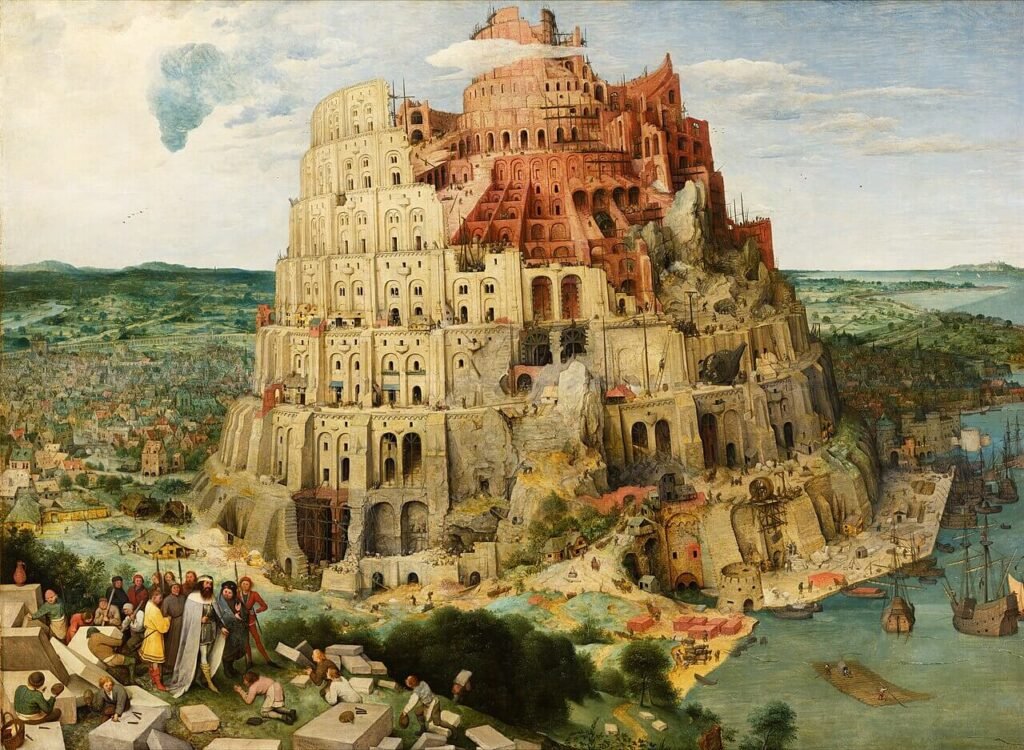
According to Genesis 11, humanity settles in one place and begins constructing a city with a tower reaching toward heaven. Its builders want to establish a collective name and prevent themselves from being scattered across the earth.
God responds by confusing their shared language, the people are dispersed, and construction ceases.
The text never says that God sends lightning upon the tower. In fact, it does not say that the tower itself ever collapses.
Only later would destruction be imagined as a way to complete the moral narrative: humanity tries to elevate itself through ambition, divine judgement descends, and arrogance receives its punishment.
Nevertheless, the imagery of the Rider–Waite–Smith deck fits this interpretation remarkably well. A crown is thrown from the top of the tower, suggesting both hubris and the sudden removal of authority.
A. E. Waite referred to the structure as a “house of falsehood”, but he also recorded several possible readings of the card, including the chastisement of pride and the mind’s attempt to understand divine mysteries.
Reading The Tower this way provides a level of consolation. If a tower was struck, perhaps it deserved to be struck. If something was destroyed, then perhaps its destruction proves that it was false.
We interpret our own lives in a similar way after an ending. We search for a defect important enough in our previous experience to justify what happened. The relationship must have been an illusion. The ambition must have been ego. The life we constructed must have been unaligned with who we truly were.
Collapse may indeed expose flaws that were previously masked by stability. Retrospective interpretation, however, can transform vulnerability into guilt. Once something has fallen, we often take its fall as proof that it should never have stood.
Spiritual language frequently creates a framework for interpreting events in this way. We are told that the universe takes away whatever no longer serves us; that rejection is protection; or that every ending makes room for something better.
These expressions attempt to protect suffering from meaninglessness. They tell us that destruction is wise and that some higher order chose which tower to destroy and where to aim the lightning.
But these expressions come at a cost. If everything that fell was meant to fall, then endurance becomes a sign of value. What remains standing appears aligned, worthy, or divinely protected. What is destroyed becomes suspicious.
Beautiful things are destroyed when they are needed most. Destructive structures can stand for centuries before collapsing.
Survival does not prove virtue or truth.
I explore this tendency to assign cause and meaning to suffering in my essay Evil Reconsidered: Theodicy and Its Limits. Identifying the flaw that supposedly caused a catastrophe can provide a sense of safety because it gives us an example of how to avoid a similar disaster in the future.
The story of Babel complicates this moral clarity. Its builders are not motivated by pride alone. They are afraid of being scattered, so they build upward to preserve unity and create a name against oblivion. Their ambition comes from a recognisable fear: disintegration, obscurity, and the loss of shared existence.
The tower therefore represents more than an ego-driven endeavour. It is also an attempt to create permanence against an uncertain world.
We create identities, relationships, institutions, and systems of belief partly because we know how easily human life can be fragmented.
When such a structure fails, it is tempting to condemn the entire motivation behind building it. But it does not become wrong to seek shelter because one form of shelter failed to protect us.
The question posed by The Tower is not merely What was false about this structure?
It is also: What did we expect this structure to protect us from?
Destruction Is Not Transformation
The language surrounding The Tower often rushes from collapse to renewal.
Because a form broke apart, space has been created. Because an identity failed, a truer version of ourselves can develop. Once an old life has ended, a new one has already begun.
Destruction removes a form. Transformation begins with how we relate to what remains.
The sequence of the Major Arcana can seem to support the more comforting interpretation. The Tower precedes The Star.
The enclosed, burning structure gives way to an open landscape, flowing water, and a nude figure kneeling beneath the night sky. The contrast is so pleasingly dramatic that it is easy to read it as a promise: suffer the catastrophe and healing will follow.
But a sequence of images is not a contract with the future.
The Star can illustrate what becomes possible once the tower no longer blocks the sky. It does not promise that everyone who loses their walls will also learn how to live without them. Exposure may look like freedom and still feel profoundly unsafe.
When suffering is immediately renamed transformation, it places another obligation on the person experiencing it. Loss must become wisdom, illness an awakening, betrayal a previously hidden gift.
A person is permitted to experience pain only if it can later be exhibited as an opening.
Meaning and understanding can certainly emerge from suffering. But meaning created afterward should not be interpreted as something that always existed within the original event.
We can create something different because of what occurred without claiming that it occurred in order to transform us. Pain can be integrated into our lives without being justified.
This distinction returns agency to the person experiencing the trauma. If destruction itself transforms us, then the event has already done all the work. We need only endure it until a new version of ourselves appears.
But destruction merely creates a new set of circumstances under which we must now live. Whether transformation will occur remains uncertain.
There is nothing automatic about it. Transformation may require grieving, interpretation, repeated choices, and ordinary forms of care that do not resemble rebirth in any way.
The Tower can expose the machinery behind a stable appearance. It can disrupt patterns that kept us trapped and make new choices possible.
But none of those things automatically provides redemption.
Merely seeing the truth does not mean that we will respond to it truthfully.
A community can overthrow an unjust system and reproduce its hierarchies under another name. Someone can experience a spiritual crisis that destroys their certainty while producing no humility.
The most important moment may therefore come after the shock, once the noise has stopped and no symbol can tell us what to do next.
The rupture may be instantaneous.
Transformation rarely is.
Collapse from a Safe Distance
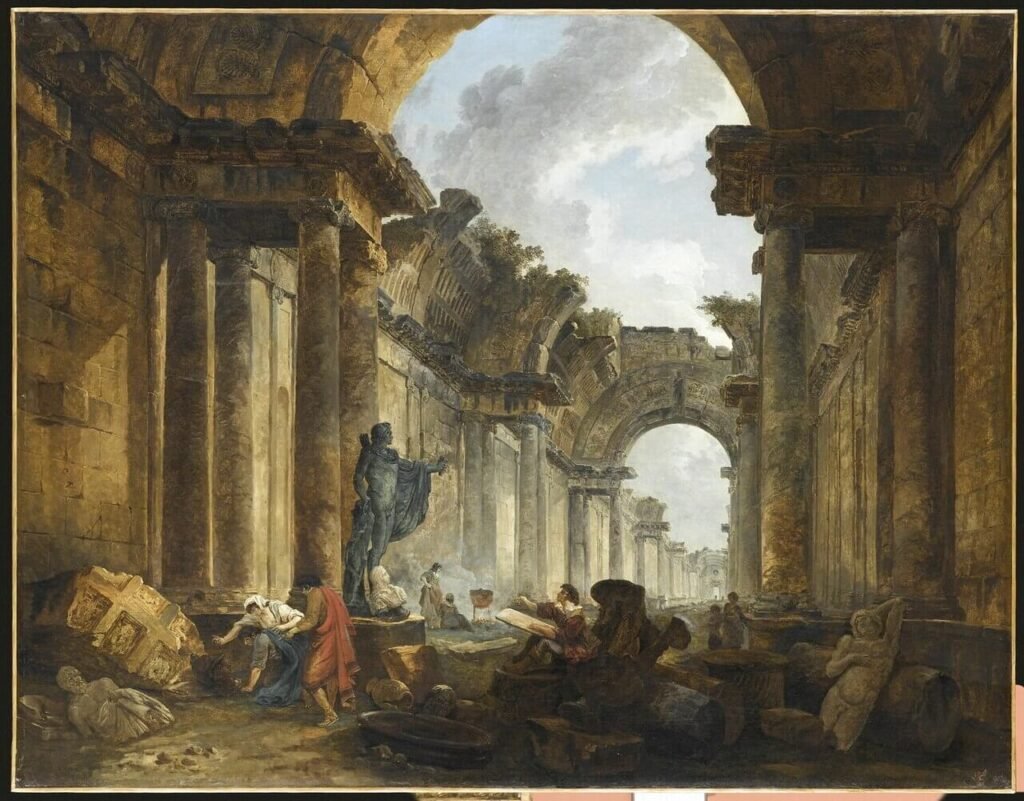
Ruins exist in a state of post-catastrophic quiet.
The wounded have disappeared from view. No one is searching for shelter, mourning a body, or estimating the cost of reconstruction.
All that remains is broken stone, open sky, and the suggestion of a history.
When viewed from afar, ruins can appear aesthetically pleasing. Walls become cross-sections, revealing how structures were made. Rooms once private now open onto the surrounding landscape. Weather enters abandoned interiors. Human ambition seems to have given way to a greater order.
Because the building can no longer maintain its facade, the ruin appears honest.
The Tower transforms catastrophe into a visual representation compact enough to hold in one hand. Lightning is frozen at the moment of impact. The crown has not yet hit the ground, and the falling figures remain suspended between the structure and the earth.
Nothing in the image needs to be cleared, buried, or repaired. We can simply view it, interpret it, and return it to the deck.
Susan Sontag explores the appeal of cinematic catastrophe in her essay “The Imagination of Disaster.” Spectacle creates emotional distance while allowing us to experience destruction through a visual representation. When destruction becomes spectacle, individual suffering is replaced by the scale of the disaster.
The Tower presents a similar paradox. Although it is frightening, it is one of tarot’s most visually compelling images. If the building stood peacefully, it would not possess the same ability to draw our attention.
We return to The Tower because it illustrates the instant when order collapses into chaos – and gives that chaos a complete design.
Real destruction has no complete design.
It is repetitive, bureaucratic, and often humiliating. It generates debris that do not arrange themselves symbolically. It forces people to depend on strangers, institutions, money, and time. Destruction does not arrive with a title at the bottom explaining what occurred.
The aestheticised ruin conceals all of this labour. It presents collapse without aftermath.
Walter Benjamin approached destruction from a different angle. In his essay “The Destructive Character”, he described a character who sees ways everywhere because destruction clears space.
Clearing away what has accumulated can feel youthful and liberating because it removes weight. But the newly created space has no inherent moral quality. It could become a garden, a prison, or simply an absence.
This ambiguity matters because many fantasies about collapse depend on physical and emotional distance from its consequences.
Someone with financial security can describe economic instability as reinvention. Someone with another place to live can celebrate the end of an old life. People protected by functioning support systems can fantasise about those systems disappearing.
For many others, collapse means the loss of medication, employment, housing, safety, time, or community. Collapse does not expand their possibilities. It reduces them.
The question is never only whether a particular structure deserves to fall. It is also: who will be standing beneath it when it does?
The Tower depicts two falling figures, but it cannot tell us whether they will reach the same ground. A symbolic image can suspend bodies inside a shared catastrophe.
Real catastrophe meets bodies already separated by power.
Some people fall with access to resources, witnesses, and a path back to safety. Others fall alone.
Tarot readings can recreate this distance when a reader interprets another person’s crisis as an essential clearing process. The card’s symbolic completeness can make destruction appear far more understandable than it feels to the person living through it.
Tarot cards can become surfaces for both projection and insight. An ethical reader must avoid demanding gratitude for someone’s devastation or declaring which parts of another person’s life were false.
A house may have felt confining and still served as a home.
It is easier to appreciate the revelation than to help clear the wreckage.
What Comes After the Lightning
Tarot does not end with The Tower.
Then comes The Star.
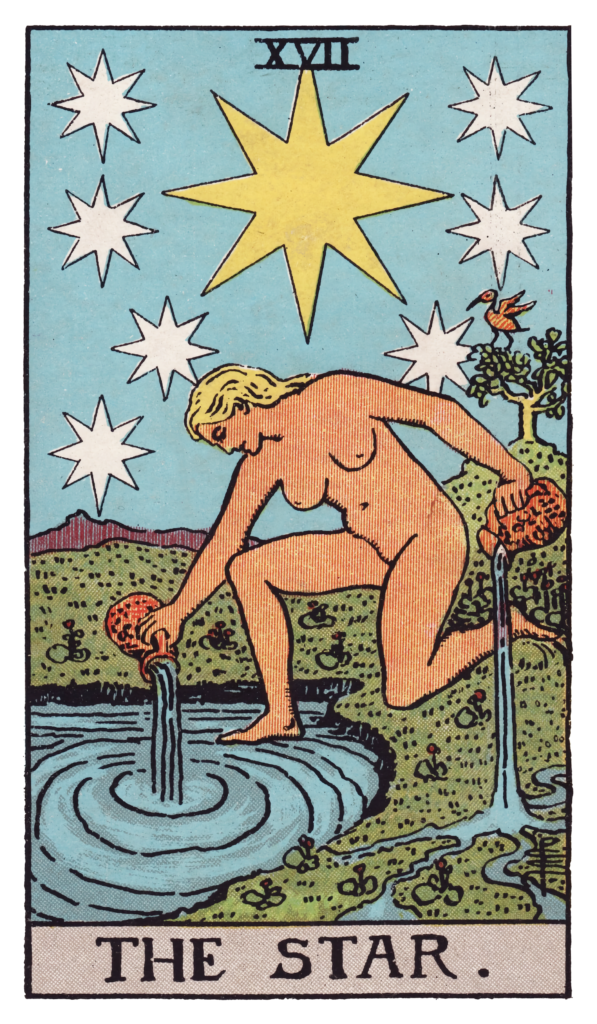
The transition between them is perhaps one of the most compelling in the Major Arcana.
The Tower is a closed, vertical structure, while The Star is an open expanse. Fire becomes water. The crowned tower is replaced by a bare figure kneeling close to the ground.
The Star does not recreate or restore what was destroyed. There is no regaining of the crown and no explanation for why the lightning struck. Water pours into water; water pours onto dry land.
After collapse comes an act of care.
The movement from The Tower to The Star is also a change in posture. The Tower reaches upward. It is fortified and certain of its own boundaries.
The figure in The Star kneels. She is exposed, yet connected to the earth, the water, and the world outside architecture.
After certainty collapses, she does not immediately begin constructing another massive system capable of replacing it.
She attends to what remains.
This is the kind of work that fantasies about destruction tend to ignore. After something ends, we need to take stock.
What was lost?
What remained?
What should never become part of another structure?
What was the tower protecting?
What was it imprisoning?
These are not questions that produce dramatic revelations. They require patience precisely when patience feels least heroic.
If we do not attend to them, rebuilding becomes an attempt to escape the ruins instead of understanding them.
Rebuilding does not always mean putting together what existed before. Some things need to remain broken. But even refusal requires ongoing care. A boundary must be maintained. A different pattern must be practised. A new form of life must be sustained after the energy of departure fades.
That is why beginnings are often easier than continuations.
It is one thing to walk away and another to keep yourself from returning. It is one thing to abandon a belief and another to live without the certainty it provided.
Surviving the lightning does not teach us how to remain in the open.
The Star offers hope without triumph. It does not ask us to consider the destruction of our past good. It simply offers the possibility of a new relationship with the body, the earth, the future, and whatever remains true once the old structure can no longer hold us.
The Tower is remembered as the moment when everything changed.
The Star asks how we will care for what change leaves behind.
Reading the Tower Tarot Card Without Worshipping It
Reading The Tower only as disaster reduces the card to fear. Reading it only as liberation turns destruction into spiritual reassurance.
The image may contain both possibilities, but it guarantees neither.
A structure may fail because it was unsustainable, because an external force damaged it, or because someone inside chose to destroy it.
Sometimes the card describes an event. At other times, it represents a revelation, an expectation, or the fear of collapse.
It can also indicate a desire to create a crisis because uncertainty has become harder to tolerate than pain.
The Tower tarot card does not always mean that something must be torn down. Sometimes it asks why destruction feels like the only imaginable form of change.
A reading might begin with different questions:
What has become impossible to keep pretending?
Is this structure collapsing on its own, or am I waiting for an event that will make the decision for me?
What protection does this structure provide, and what does it prevent?
Who will bear the greatest cost if the structure collapses?
Am I calling this transformation before the work of transformation has begun?
What will require care after the lightning strikes?
These questions allow The Tower to remain severe without making it cruel.
The card can name instability, rupture, and exposure without declaring suffering necessary simply because symbolism can be found within it.
Its power lies in its refusal of permanence. Every identity and institution has a history and, therefore, the possibility of an ending. But impermanence alone cannot tell us what is worth preserving.
Some towers are prisons. Some are shelters. Most are both, depending on who built them, who controls the gates, and who is permitted to leave.
The task is to examine the structure closely enough to recognise the difference.
Our romance with destruction begins when we prefer the purity of ruins to the compromise of repair. It deepens when we confuse pain with truth and crisis with courage. It becomes dangerous when the suffering of others is absorbed into a beautiful story about necessary endings.
Look again at the card.
The lightning illuminates The Tower for only a moment. It reveals the walls, the crown, the fire, and the falling figures.
But illumination is not understanding. The flash disappears almost as quickly as it arrived.
What matters is what we can still see when the dark sky returns.
The Tower does not promise that destruction will free us, that what falls was false, or that the ruins will naturally become foundations.
It offers a harder truth:
Nothing we build is guaranteed to remain.
What follows is not fate, but responsibility.