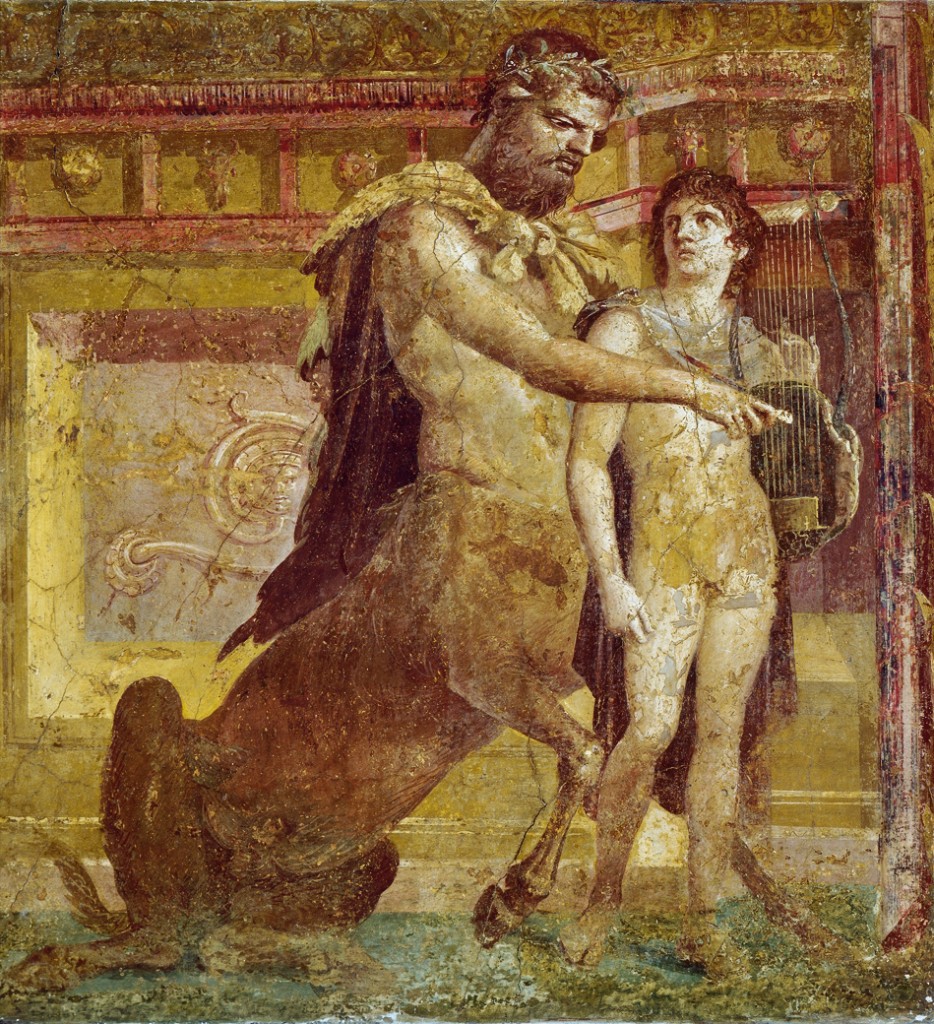
- Featured image: The centaur Chiron teaching Achilles how to play the lyre, Roman fresco from Herculaneum, National Archaeological Museum of Naples (1st century CE)
Chiron’s Wound Between Myth, Meaning, and Astrology
Chiron represents the space in which ancient myth intersects with both modern astrology and the realm of psychology. It is a myth about an unhealed wound, a repeating cycle with no end, and a teacher who ultimately chooses to leave behind the life he created with love.
Chiron’s story speaks to our psychology of suffering, the structure of healing, and the language we use to describe natal charts today.
Chiron is one of the most powerful archetypes of contemporary spirituality because he represents a universal truth:
Sometimes, the greatest wellspring of knowledge comes from a wound that will always be open; and sometimes, the most sacred choice you can make is to choose release over an endless cycle of repetition.
Chiron in Myth: The Wound Without Closure
The centaurs of Greek mythology are characterized by their lack of self-control and unbridled behavior; in contrast, Chiron (Χείρων) is a figure who is both controlled and wise.
Chiron, son of Cronos and the nymph Philyra, is educated in medicine, prophecy, and the arts by Apollo and Artemis. In turn, he becomes the mentor of heroes – Achilles, Jason, Heracles, and Asclepius – to illustrate the power of knowledge.
Chiron’s life is altered by a fateful mishap. During a battle between the centaurs, Chiron is accidentally shot by a poisoned arrow containing Hydra venom by Heracles. Although the poison is lethal to mortals, Chiron is immortal.
Thus the paradox:
- he cannot die
- he cannot heal
- he cannot return to life as it was
- he cannot endure this cycle indefinitely
There is immense symbolic significance to this action: the choice to relinquish a divine gift due to the unbearable nature of repeated pain.
Zeus places Chiron among the stars as part of the constellation Centaurus, thus converting the wounded healer into a celestial educator.
Chiron’s myth does not celebrate suffering but rather defines its limits. Even the greatest of wisdom can succumb to suffering when the cycles of it continue endlessly.
The Wounded Healer Archetype
Chiron’s wound has given rise to a very long line of psychological imagery. Carl Jung described the “Wounded Healer” in which the therapist is capable of healing others due to their own wound. Later, other people have taken that image and turned it into a model of both pastoral and spiritual care – the healer does not escape the wounds they suffer through, but instead work from them. Thus Chiron becomes an example of a person who teaches because he is not heroic in his ability to endure pain, but rather he learns how to teach with the wound as part of his life.
Yet the ancient myth is also clear about limits; the wounded healer can only tolerate pain for so long. Chiron’s giving up is not a failure, it is a transformation – his wound becomes a star, a sign in the sky and a guide to others who are to follow him.
Chiron in Astrology: The Bridge Between the Personal and the Transpersonal
Modern astrology has only recently adopted Chiron – it was first identified by Charles Kowal in 1977, and he named it after the mythic centaur (uncannily appropriate).
Chiron doesn’t neatly fit into the asteroid or comet category – that’s why astronomers created a new group and named the class Centaurs – they are “hybrid” objects, half asteroid/half comet, just like mythological centaurs are half human/half horse.
It is believed that it originates from the Kuiper belt beyond Neptune and Pluto. Chiron was nudged into an unstable orbit toward the planets due to gravitational pull of Neptune. The resulting orbit is shorter than that of most objects in our solar system and provides a symbolic reflection of the astrological qualities associated with Chiron – it is located between Saturn and Uranus where the boundaries (Saturn) meet liberation (Uranus).
Astrologers often view Chiron transits as times when an old wound reopens – not to punish, but to integrate and soften. Chiron’s motion is slow and erratic, mirroring the unpredictable nature of healing itself.
Chiron as Archetype
Astrologically, Chiron represents:
- the wound we carry without fully healing
- the place where life feels unfair or painful
- the skill and sensitivity developed through suffering
- the longing to transcend repetition
- the wisdom gained through endurance and surrender
It is not an easy archetype. Chiron marks the place where a person feels “different,” vulnerable, or repeatedly challenged – and simultaneously where they develop their deepest gifts.
Chiron by Sign: The Nature of the Wound
A brief overview of Chiron through signs:
Aries: wounds around identity, self-assertion and courage
Taurus: wounds around worth, stability and embodiment
Gemini: wounds around communication, intellect and voice
Cancer: wounds around belonging, safety and early family
Leo: wounds around visibility, creativity and pride
Virgo: wounds around perfection, health and usefulness
Libra: wounds around balance, relationships and fairness
Scorpio: wounds around trust, intimacy and power
Sagittarius: wounds around belief, meaning and truth
Capricorn: wounds around responsibility and authority
Aquarius: wounds around belonging to the collective
Pisces: wounds around faith, dissolution and sacrifice
Chiron by House: Where the Wound Lives
1st House: the self
2nd House: survival, security and money
3rd House: learning, speaking and siblings
4th House: family, origins and psychological roots
5th House: love, creativity and risk
6th House: health, work and service
7th House: partners, mirroring and projection
8th House: trauma bonds, loss and shared resources
9th House: worldview, religion and travel
10th House: career and public identity
11th House: friendships and groups
12th House: the unconscious, the unseen and hidden wounds
Chiron Aspects: Teaching Through Pain
Chiron-Sun: identity shaped through the wound
Chiron-Moon: emotional wound repeating through life
Chiron-Venus: wounds in love, aesthetics and self-worth
Chiron-Mars: wounds around action or aggression
Chiron-Saturn: chronic patterns and karmic weight of ther wound
Chiron-Uranus: sudden activation of trauma
Chiron-Neptune: spiritualized wounds and martyrdom patterns
Chiron-Pluto: deep, transformative trauma and regeneration
Leaving the Cycle: Chiron’s Lesson
Chiron’s value lies in recognizing limits – there are certain relationships, roles, patterns or beliefs for which we will endure as long as we are able, but after that point our repeated endurance may feel meaningless.
Chiron reminds us that:
- we don’t have to remain within the bounds of a wound in order to learn something about ourselves from it
- wisdom and pain can coexist
- release of a pattern (of behavior) can be far more important than the willingness to persist
His story serves as an antidote to stories that celebrate never-ending endurance. Chiron doesn’t “get through” his pain; he doesn’t “fully heal” and he doesn’t “keep on smiling.”
He chooses to transform, to tell the truth, and to move beyond the cycle of repetition.
Chiron wasn’t put in the sky as a symbol of his suffering, but as a reminder that the ability to release oneself from a pattern or belief system leads to wisdom and insight.
Conclusion: Wounding, Withdrawal and the Thresholds of Transformation
In astrology, mythology, and theology, the theme of the “wounded one” – for example: Orpheus, Jonah, Achilles, and perhaps the most poignant of all, Chiron – repeats a common pattern: when the pain of staying as things are becomes unbearable and the soul searches for a threshold.
Occasionally, that threshold may appear as voluntary exile – occasionally, it will manifest as spiritual refusal; and sometimes, it will show up as the very act of dying. Each time, a fundamental conflict arises between love for something and the pain that love brings. Chiron represents this conflict most profoundly. Unlike heroes who flee, collapse under their circumstances, or die from them, Chiron appears in a state of liminality between enduring and releasing. His wound cannot be cured, yet he continues to teach, heal and guide. He is forever in pain, and yet he will not use that pain to harm anyone else.
Finally, Chiron’s death is not an escape from pain, but rather a sacrificial act to restore cosmic balance – not through despair, but through clarity – that living with chronic, unbearable pain without hope of fulfillment is a distortion of both physical being and spirit. The last act of Chiron is a symbolic restoration of harmony to the universe.
As an astrological archetype, Chiron is exactly that paradoxical instant – the exact moment that one has reached the limit of what can be endured.
When Chiron appears in a natal chart, it indicates that there exists a location in a person’s life where that person can refuse to remain within patterns that cause them pain – regardless of how much a part of their lives these patterns have been. This is the point at which one must decide whether to continue the cycle of familiarity or experience the potential of freedom from the wound.
The stories of Orpheus who glances back and loses what he loves, Jonah who flees from God until the sea swallows him… are not simply stories of pain, but are stories of thresholds – moments when a soul knows that remaining the same is not possible. They illustrate the inner guidance in which pain teaches – where exile is a rite of passage, and surrender is a gateway to another way of living.
Understanding Chiron means recognizing that the pain associated with continuing in cycles of behavior previously survivable but now unbearable, is itself a message – a signal to take a step over the line into what would have previously been unbearable, but is now necessary to survive.
Both myth and astrology insist that this moment is holy and not to be ashamed of. It is the moment in which a life turns toward another horizon.
REFERENCES
Primary Sources
- Apollodorus. The Library. 2.5.4.
- Aristotle. Parts of Animals 3.2.
- Diodorus Siculus. Library of History 4.12.8.
- Ovid. Fasti 5.379–414; Metamorphoses 2.636–675.
Secondary & Interpretive Works
- Campbell, Joseph. The Hero with a Thousand Faces. Princeton University Press, 1949.
- Jung, Carl Gustav. Collected Works, Vol. 16: Practice of Psychotherapy. Princeton University Press, 1966.
- Nouwen, Henri J. M. The Wounded Healer. Image Books, 1972.
- Greene, Liz. Chiron and the Healing Journey. Weiser Books, 1999.
- Seddon, R. The Healing Myth of Chiron. Journal of Analytical Psychology, 1989.
Astrological Works
- Clow, Barbara Hand. Chiron: Rainbow Bridge Between the Inner and Outer Planets. 1987.
- Reinhart, Melanie. Chiron and the Healing Journey. Chiron Publications, 2010.
- Arroyo, Stephen. Astrology, Psychology, and the Four Elements. CRCS, 1975.
Leave a Reply