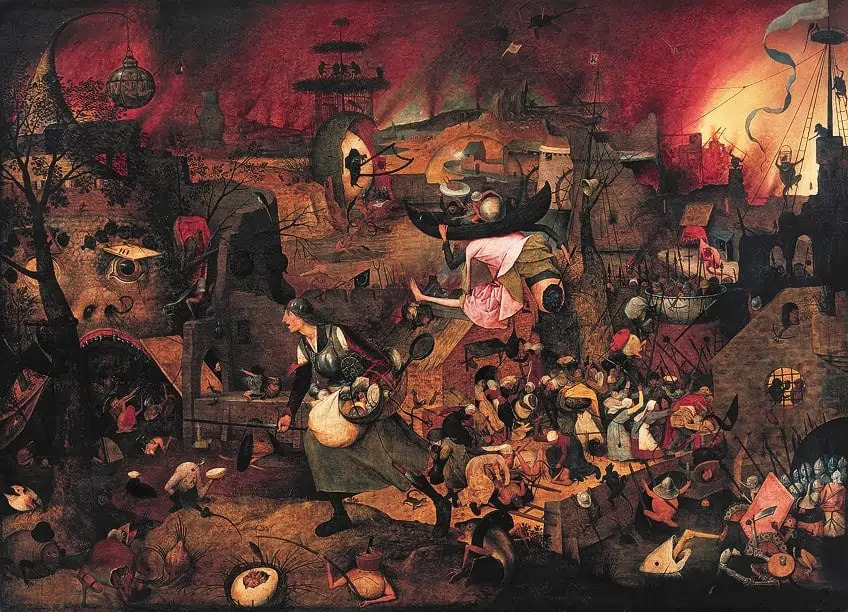
- Featured picture: Dull Gret (1563) by Pieter Bruegel the Elder, located in the Museum Mayer van den Bergh in Antwerp, Belgium; Pieter Brueghel the Eldr, Public domain, via Wikimedia Commons
Evil: Theology’s Unanswered Question
The problem of evil is one of the most evasive problems of theological thought: if God is all-powerful, all-knowing, and completely good, then how can there be evil and suffering in the world? The problem of evil (or, more formally, theodicy) has generated debates for thousands of years. The classical answers – Augustine’s privation theory, or Leibniz’s ideas of best of all possible worlds – have defended divine goodness and rationalized faith with reason.
But despite centuries of detailed argument, the question that problem of theodicy poses, didn’t find, at least in my opinion, an appropriate and all encompassing answer.
What came closest to offering clarity, for me personally, was not a theological solution, but a philosophical inquiry into the nature and language of evil.
In contrast to classical theological discussions on theodicy, philosopher Lars Fr. H. Svendsen has approached evil, not by trying to resolve the metaphysical problem of it, but by investigating what we actually mean when we say that something is “evil” and the notions of the idea of it in culture and morality. Svendsen’s Philosophy of Evil makes no attempt to justify God, but instead interrogates evil as a construct of human experience and imagination.
Why and Where Traditional Defenses Fail
Starting with the early Church Fathers, a tradition, called theodicy, developed in Christian theology that sought to understand evil in relation to divine providence. The most influential early understanding was presented by Augustine (354–430 CE), who argued that evil was not a substance in its own right, but a privation of good which arises from the misuse of free will. This identification of evil with a misuse of free will remains a central bedrock of Christian theodicy, which emphasizes that we are morally responsible rather than God being morally culpable.
Later thinkers in the medieval period (e.g., Thomas Aquinas), further developed this framework by treating evil as a failing that was allowed by God within divine order – much like as we may see shadows that help to illuminate depth created by light.
Starting from early modern period and into the Enlightenment, the most systematic account was offered by Leibniz (1646–1716), who suggested that the world that all of us are a part of, with all of its “faults”, was the “best of all possible worlds” God could make, with the right amount of freedom, order, and space for human self-realisation.
Later thinkers, like David Hume, particularly, posed the important question of how to reconcile the degree and nature of suffering with the goodness of God. Dostoevsky, in The Brothers Karamazov, dramatizes humanity’s moral outrage at a God who will allow the suffering of innocents.
In the twentieth century philosophers such as Alvin Plantinga created new accounts of theodicy: free will defenses and soul-making theodicies, respectively, but, still with a sense of incompleteness when justifying the existence of evil, most critically with heinous acts like the Holocaust.
Theodicy debates struggle with the question of why evil exists in the creation of God and propose solutions that justify its existence. Svendsen, however, in his book Philosophy of Evil, turns that problem around by asking: what do we mean when we say something is “evil”?
Starting From a More Stable Ground: From Theodicy to Cultural analysis
Lars Fr. H. Svendsen’s Philosophy of Evil is not a theodicy in the traditional sense, because it does not aim to justify God; it rather approaches evil as a concept, a cultural construct and a lived experience. Svendsen claims that evil is not just an objective metaphysical characteristic of the world, but also a category that humans use to make interpretations of acts, intentions, and events. To think about evil requires us to consider the history, psychology, and cultural framing of this category.
Svendsen begins by trying to ask what we mean when we call something “evil”. Evil is different from ordinary wrongs in that it typically suggests radical destructiveness or a moral void; to call something evil is to speak of both a judgment and a revulsion. In Svendsen’s words, evil is “a concept that carries with it a clarity of fascination as well as condemnation”. Evil invokes horror, but also a certain allure; as we know, from pop culture’s obsessions with “villains”, atrocities, and the grotesque.
Svendsen references Hannah Arendt’s term “the banality of evil” to assert that evil, rather than arising from explicitly demonical intent, is often committed by ordinary human beings in ordinary situations. However, culture portrays evil as monstrous and exceptional – as figures of radical otherness, they embody pure malice. He argues that it seems banal in execution and monstrous in the cultural imagination.
One of Svendsen’s most significant contributions is the historical and conceptual contextualization of what is considered to be evil by any society. What is condemned as evil may, in another historical context or another culture, be regarded as not. Political regimes re-position evil according to their needs, which could be politically viable measures that could include labeling and interpreting an entire group as enemies. Evil, in that sense, does not appear to be a being or a fixed object, but rather a fluid idea constructed by changing cultural and moral contexts.
Perhaps the most interesting aspect of Svendsen’s push-back on theodicy, is his repudiation of efforts to make evil ultimately meaningful. He argues that rendering the suffering of innocents as “necessary” for any greater design trivializes the suffering they have endured, further noting that evil often comes down to absurdity and resists any rational order.
Conclusion: Evil as a Problem of Meaning and Understanding, Not Metaphysics
Classical theodicy has attempted to exonerate God from the claim that evil undermines divine goodness. While these narratives still have intellectual and theological value, they leave the existential reality of suffering mostly unarticulated.
Svendsen’s Philosophy of Evil marks an important pivot – reclaiming “evil” from an abstract justification, and bringing it to a cultural, psychological, and ethical study. Evil, he argues, is not just a metaphysical puzzle to be solved, but also a human idea – one that organizes our judgments, fears, and moral responses.
This does not “resolve” the problem of evil, it simply changes the question. Rather than asking why God allows evil, Svendsen proposes for us to ask: how humans define evil, how societies reproduce or resist it, and how individuals must confront it in their own lives.
Svendsen’s work thus stands as a corrective and complementary challenge to the tradition of theodicy:
evil is not uniquely an intellectual challenge to theology – it is, more importantly, the lived problem of culture and human meaning-making.
Leave a Reply