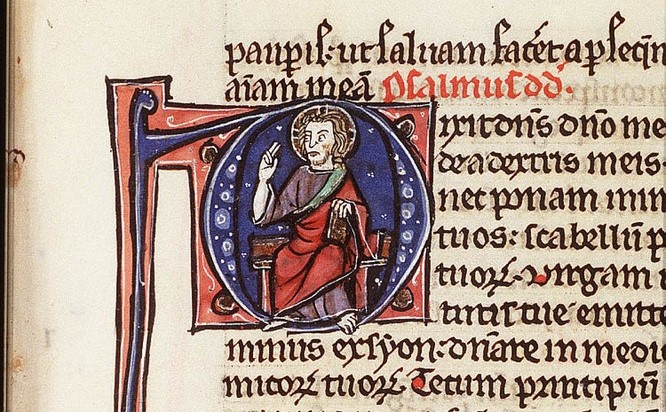
- Featured picture: Christ Pantocrator, a specific depiction of Jesus Christ as the “Ruler of All” – scan of a medieval
manuscript (1300-1500) – source: europeana.eu
Shame creates a silence — not peaceful and reflective, but rather an oppressive one. This silence resonates both within the individual psyche and in relational worlds. It darkens self-perception and moral thought, and masquerades as honest or holy when it is neither. Shame represents an unarticulated emotional undercurrent beneath some of the theologies we inherit — which form belief systems and the very design of the self.
In The Dogma of Christ, Erich Fromm approaches Christianity from the perspective of a psychoanalyst and social philosopher rather than a theologian. In considering the psychological function of religious dogma, particularly the transition from Jesus’ early and egalitarian message to hierarchies constructed by institutional Christianity – he works to bring together psychology and theology.
Many of the same explorations are present in psychologist Gershen Kaufman’s groundbreaking study Shame: The Power of Caring. Kaufman examines shame as a primordial affect that ruptures the self, closes down intimacy, and perpetuates internalized authority.
By comparing these two perspectives, we can ask a provocative question: what if much of what has been interpreted as religious guilt is really shame that has been historically codified and internalized psychologically? And what if we were to dismantle these inherited emotions to retrieve a more grounded theology and sense of the self?
Fromm: Dogma as Psychological Authority
Erich Fromm’s book The Dogma of Christ is not polemic against faith, but rather a critique of how thought is sedimented through the pressures of history. Fromm argues that the early Christian communities – egalitarian, self-authorized, revolutionary – were transformed as Christianity became co-opted by state power. In the process of that transformation, the teacher Jesus – a prophetic figure – who upended social conventions, was turned into a divine intermediary whose role was to reconcile humanity to an all-powerful God, portrayed in paternalistic terms.
Fromm writes:
“The dogma of Christ… is not a product of spiritual experience but of psychological and political needs of a specific historical period.”
The dogma served the needs of a developing imperial state: direct experience, solidarity, and social liberation were replaced by submission, obedience, and moral conformity to authority. In psychological terms, Fromm argues that the reproduction of the socialized, so called, “father complex”, located within the subject entrenches dependency, guilt, and emotional subordination.
The Church was never simply just an authority, but this legitimated hierarchy became further internalized as a super-ego structure in the subject. The divine judge replicated the punitive voice, which Fromm and Freud presume to constitute, in their estimation, the development of neuroses — a view reframed in contemporary psychology through concepts such as internalized shame and authoritarian attachment patterns. The psychological economy of love is reduced to a conditional performance and salvation, framed, not as a synthesis to love, but obedience and submission.
He writes about the institutionalization of Christianity; specifically Creeds like the Nicene Creed, as systematic movement from a communal, emancipatory spiritual experience towards a formalized hierarchy of authority. Jesus, the figure of compassion and love, as the threat to the established order, was mythologized into the otherworldly Christ, whose divinity justified the authority and hierarchies he purported to question.
Fromm observes:
“The Christ myth became the ideological weapon of the ruling classes… an image of submission to authority rather than an invitation to rebellion against injustice.”
This represents the transformation of Christianity from the apocalyptic sect of the poor to a pillar of imperial ideology. The shift was not simply enacted through a theological switch in meaning, but as well, to fortify a new psychic demand – to submit/obey versus to resist/act.
Fromm argues that this development represents almost a cultural regression in psychological terms. The process that dogma – instead of developing autonomy, providing spiritual growth, or learning mature love, was aspiring to emotional infantilism: the believer’s role as a child, the Church’s role as a parent, and God’s role as the ultimate paternal. This emotional complex enabled the conditions for shame to take hold, camouflaged as reverence, repentance and awe.
Kaufman: Shame as the Hidden Emotion
Gershen Kaufmann’s writing is a psychological complement to Fromm’s sociological analysis. For Kaufmann, shame is more than a moral emotion related to doing something wrong; it is like a rupture in the self. Shame, he writes, is the affect that occurs whenever the self becomes exposed and seen as deficient. Unlike guilt, which includes regret over specific behaviors, shame implicates the entire self.
As Kaufmann writes:
“Shame is the most disturbing affect. No other affect is more deeply intertwined with the sense of self.”
Shame is formed in the very earliest relationships, often before words. Shame is first sensed during moments of misattunement between infant/child and caregiver —looking away, raising a voice, neglecting a need. If unresolved, the moments of misattunement become habitual. The habitual misattunements coalesce into self-talk scripts that become self-determining: “unworthy”, “not enough”, “must not be seen.”
Shame’s invisibility is worth noting since it is particularly relevant to religious structures. Shame appears as more respectable forms — humility, piety or moral restraint. Yet shame, even in its more respectable and benign forms, always contains the same implicit requests on the self; it prohibits vitality, agency, and the quality of being truly connected. In systems and structures where perfectionism is exacted, and sinfulness is unavoidable, shame is offered as the affective default — and the commodity of control.
Theological Shame and the Birth of the Superego
Fromm and Kaufman come together in their understanding of internalized authority. Fromm uses two perspectives, historical materialism and psychoanalysis, to describe how religious ideologies bring in structures of submission.
Kaufman describes how these structures are experienced and reproduced in the emotional body. Theological declarative statements such as original sin tell the believer that they were broken from birth, for example. When repeated in the embodied forms of sermons, prayers, and confessions, the “truth” of affect happens — I am flawed, and I must earn love.
The alignment between theology and shame is no accident. It serves a two-fold purpose: it disciplines actions and maintains loyalty. If God knows everything and judges in a moral sense, the believer is both subject and enforcer. Kaufman’s idea of a “shame-bound self” describes a person who is always on “self-surveillance,” while Fromm’s idea of the authoritarian character describes a person who lacks freedom and remains reliant on external moral orders that alleviate existential discomfort.
Beyond Guilt: The Path Toward Integration
Both of these thinkers ultimately point to liberation – not from morality, but from psychological bondage. Fromm advocated for a humanistic ethics based on relatedness, spontaneity, and love. He saw Jesus’s original message as providing a blueprint for such a life, which was later buried under impeachment, dogma, and hierarchy.
Kaufman, for his part, offers a way to healing. He understands shame not as a permanent emotional scar or wound, but as an emotion that can be acknowledged, understood, and gradually reintegrated into our emotional cores. When we meet shame with awareness and compassion, its hold is lessened. The defensive structures we construct to guard against our own vulnerability – the false self – can begin to soften and crumble away.
To move away from theological shame does not imply secularism or faithlessness. It implies the ability to discern between belief and control; discourse and management; reverence and fear. To recognize that the image of the punitive, all-seeing God may be less a reflection of divine reality than a projection of inherited trauma and emotional injury.
Conclusion: Reclaiming Sacredness Without Shame
If shame is the hidden legacy of later developed Christian religious doctrine – to heal the shame requires a deconstruction both intellectual and emotional. Fromm gives us the tools to break down the socio-political mechanisms that constructed that belief while Kaufman provides us with the language to feel the pieces left by those mechanisms.
If so, the task is neither to venerate, nor to dismiss religion, but to sift through it. To ask: What is in this tradition of religion that creates life? What silences? What affirms love, and what affirms fear?
There is sacredness that exists beyond shame – not in spite of our humanity, but in light of our ability to engage it with honesty. To reclaim that sacredness means to ponder Fromm’s art of being – in connection, dignity, and freedom.
And maybe, in that, we can begin to discern a silence of a different sort, not the muteness of shame but the stillness of presence — of the kind where the self is not judged, but met.
Leave a Reply